
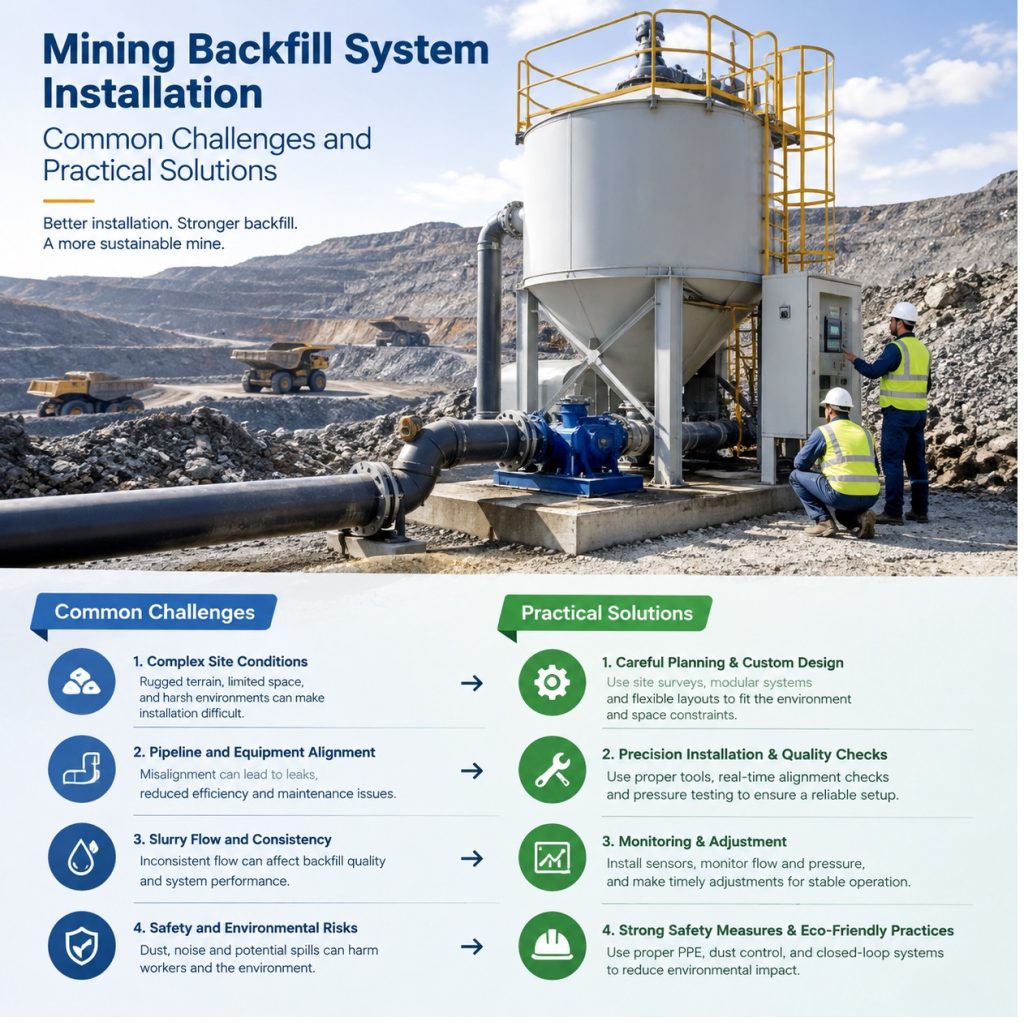
 A mining backfill system is not a collection of pumps, pipes, and silos. It is a promise that voids will be filled on schedule, without turning the mine into a laboratory for expensive mistakes. Installation is where that promise either holds or starts leaking.
I have spent enough commissioning weeks underground to know the pattern. The drawings look clean. The equipment arrives. Then the first pour reveals a plugged line, a split flange, a binder feeder that cannot hold tolerance, and a control room full of alarms that nobody owns. None of these are exotic failures. They are ordinary installation problems that get ignored until they become production problems.
If you are planning a new backfill plant or retrofitting an older one, here are the challenges that matter and the practical moves that keep them from eating your schedule.
Tailings never behave like the lab sample. The lab report says the slurry will flow at a certain density. The mine sends something wetter, coarser, or more variable. A backfill system installation that assumes one recipe will struggle on day one. The practical solution is to design for a range, not a number. Sample the tailings across shifts. Test with the actual binder and water chemistry. Build in inline density and flow measurement. Give operators a clear way to adjust binder and water without guessing. If the system cannot tolerate variability, the pipeline becomes the mixer, and that is a bad place to mix.
Underground geometry is never as built. Surface drawings are optimistic. Underground is a different world: tight corners, low backs, old workings, wet ground, and services that appeared after the survey. A pipeline route that looks smooth on paper can turn into a series of high spots and sharp bends. Those are where air pockets form and wear accelerates. The fix starts before fabrication. Laser scan the route. Build a real 3D model. Use modular pipe spools that can be rotated and trimmed on site. Add air release valves at high points and drain points at low points. At vertical drops, use drop boxes or energy dissipators instead of letting slurry free-fall and hammer the elbow below. The installation crew will thank you, and the maintenance crew will thank you more.
Logistics can strangle the best design. Backfill installations often happen in remote locations with one access road, a busy shaft, and a production schedule that does not care about your commissioning plan. Every oversized skid, every late delivery, and every missing cable tray becomes a bottleneck. Modularization is the practical answer. Pre-assemble as much as possible at the fabrication yard. Test the mixer, pump, and control panel before they ship. Use skids that fit the cage or the drift. Stage deliveries around the mine’s constraints, not the vendor’s convenience. A backfill system installation that respects the mine’s logistics is a system that gets commissioned on time.
Pressure surges do not announce themselves. Slurry is heavy. When a pump starts, stops, or a valve closes too fast, pressure can spike well above steady-state. Flanges leak. Hoses burst. Instruments fail. The solution is not to buy thicker pipe everywhere. It is to model the surge, specify pressure-rated components, and set soft starts, variable frequency drives, and controlled valve sequencing. Slow down the system where it matters. Install pressure transmitters at critical points. Train operators on proper start-up and shutdown. Most surge damage is a procedure problem wearing a mechanical disguise.
Wear is predictable, but only if you look for it. Backfill pipelines do not wear evenly. Bends, reducers, and the discharge end take the punishment. If the installation treats every pipe as equal, maintenance becomes a constant emergency. Use wear-resistant liners at known hot spots. Rotate spools where possible. Design access for inspection. Keep spare elbows and gaskets on site. Track wear rates from the first week, not after the first failure. A small amount of condition monitoring turns a reactive maintenance budget into a planned one.
Binder dosing is a quality control problem, not just a feeding problem. Cement, fly ash, slag, and other binders are expensive. They also create dust, bridge in hoppers, and punish inaccurate feeders. A backfill system installation that does not calibrate the binder circuit under real conditions will produce weak fill or overuse binder to compensate. The practical approach is to install proven loss-in-weight or screw feeders with proper isolation, ventilation, and dust collection. Calibrate them with the actual material. Tie the dosing to the slurry density and flow. Give the operator a clear readout of binder per cubic meter. When the numbers are visible, the mix becomes controllable.
Controls and integration are where good projects go to die. Backfill plants often sit between several vendors: mixer supplier, pump supplier, valve supplier, instrumentation contractor, and the mine’s existing control system. If no one owns the control philosophy, the result is a patchwork of PLCs, alarms, and screens that do not talk to each other. Fix this before installation. Define one control narrative. Agree on tag naming, alarm priorities, and fail-safe positions. Run factory acceptance tests with the actual logic. Pre-commission loops before slurry ever enters the line. Redundancy is worth the cost for critical instruments and pumps, but only if operators know what to do when the primary fails.
Commissioning is not a formality. The most common mistake is treating commissioning as the last two weeks of the project. That is when you discover the water supply is undersized, the air compressor is shared, the drain sump is too small, and the training happened six months ago. Commissioning should start in design. Build a commissioning plan with hold points. Require clear punch lists. Test with water, then with slurry at increasing density. Flush and drain the system properly after every trial. Train operators on the actual plant, not a generic slide deck. Leave behind a spare parts list that matches what was installed, not what was quoted.
Safety has to be designed into the installation, not added around it. Backfill systems bring high pressure, heavy equipment, confined spaces, dust, and chemical additives. Installation crews and future operators need guarding, lockout points, emergency stops, and clear isolation procedures. Risk assessments should cover not only normal operation but also blockage removal, line flushing, and maintenance. If a worker has to stand under a pressurized line to open a valve, the design failed. Make the safe way the easy way.
The best backfill installations are boring. Pumps run. Lines stay clear. Binder numbers hold. Operators trust the system. That does not happen by accident. It happens when the installation is planned with the same rigor as the process design.
If you are evaluating a backfill system installation partner, look for one that asks about tailings variability, underground as-built conditions, logistics, surge, wear, and commissioning before talking about equipment price. The cheapest installation is the one you only have to do once. Bring the installation team into the conversation early. The mine will feel the difference every shift.
Comments are closed, but trackbacks and pingbacks are open.