
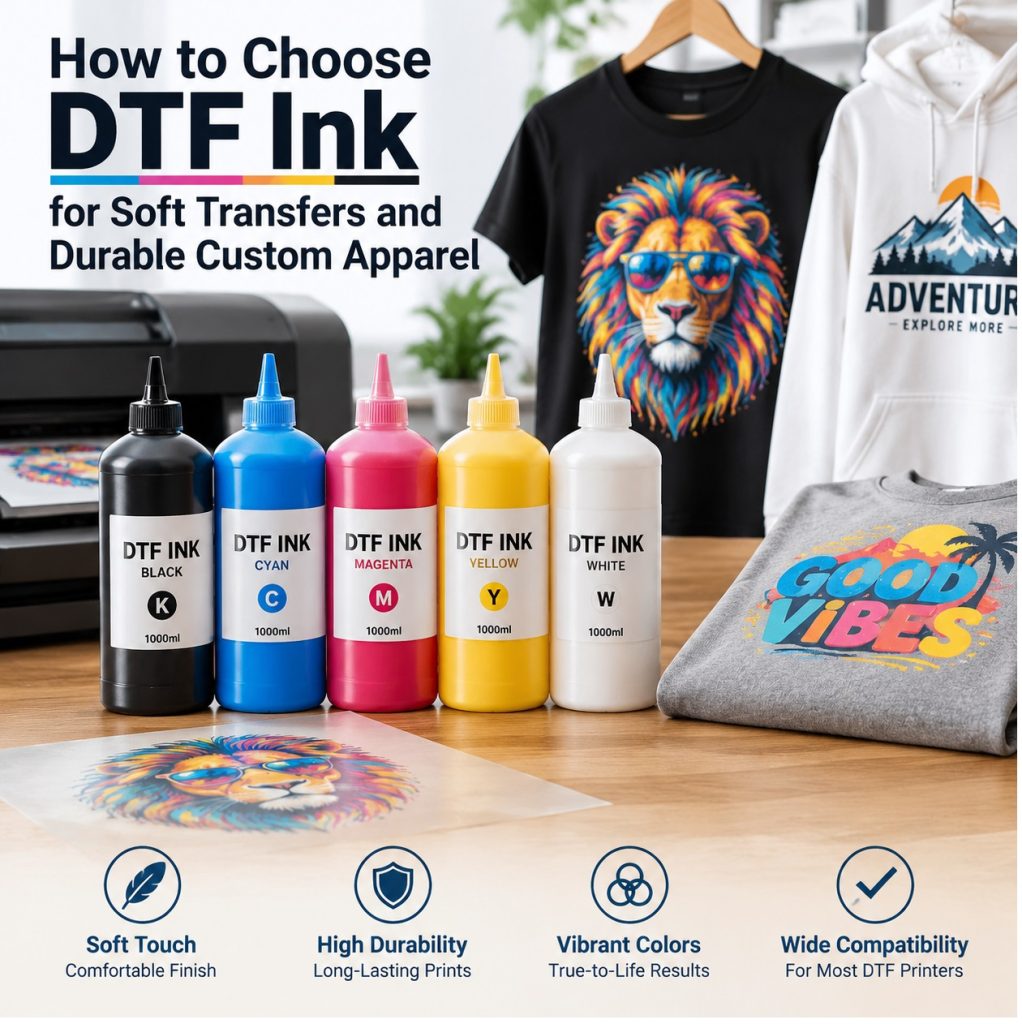
 A customer once dropped off a shirt for a reprint, three weeks after buying it. The design had cracked into a spiderweb across the chest, and the once-vibrant colors looked like a faded photograph left in the sun. That single return cost me more than the ink savings I’d chased for an entire quarter. Since then, I’ve treated DTF ink as the backbone of my shop, not a line item to bargain-hunt.
If you’re printing custom apparel, the ink you feed your printer decides whether your transfers feel like part of the fabric or like a plastic sticker waiting to peel. Here’s how to separate the inks worth buying from the ones that will haunt your reviews.
Start with pigment quality, not price per milliliter. Soft transfers begin with fine, evenly milled pigment particles. When pigment is coarse, the printer has to lay down more ink to reach full opacity, and more ink means a thicker film sitting on top of the garment. That thickness is exactly what customers describe as “rubbery” or “cheap.” A well-milled ink delivers deep color with a thinner deposit, so the print drapes with the shirt instead of fighting it. Ask your supplier for the pigment particle size or, better, request a printed sample and stretch it in your hands. If it feels stiff before it even hits a shirt, walk away.
Pay attention to how the ink behaves in the white channel. DTF lives and dies by its white base, and white ink is the hardest formulation to get right. A good white stays opaque after a single pass, doesn’t yellow during curing, and keeps its brightness through repeated washes. Cheap white ink often looks great on day one and turns dingy by wash five. Print a test swatch, cure it, and run it through ten hot washes with detergent. If the white goes cream or grey, you’ve found your answer.
Viscosity consistency matters more than the number on the spec sheet. Whether you’re running a converted printer or a dedicated DTF machine, the ink needs to flow predictably through the printhead. Inconsistent viscosity causes banding, clogged nozzles, and wasted film, and those problems show up mid-order when you can least afford them. Shake your bottles, check for sediment, and note whether the ink separates in storage. Some settling is normal; a thick sludge at the bottom that won’t reincorporate is not.
Look for a forgiving curing window. Every DTF ink has a temperature and time range where it cross-links properly with the adhesive powder. Premium inks tolerate a wider window, which means small fluctuations in your oven or heat press won’t ruin a batch. Budget inks demand surgical precision, and that’s a gamble you don’t want to take on a fifty-shirt order due Friday. Test your ink at the low and high ends of its recommended cure range and see how the stretch and wash results hold up.
Think of ink, film, and powder as one system. The best ink in the world will underperform if it’s paired with a film that can’t release it cleanly or a powder that won’t bond with it. When you evaluate a new ink, test it with your existing film and powder first. If the results disappoint, try the supplier’s recommended combination before writing off the ink entirely. Many “bad ink” stories are really mismatched system stories.
Build a simple testing routine and stick to it. Print the same design every time you try a new ink. Include fine lines, solid blocks, gradients, and small text. Cure it according to the supplier’s instructions, press it onto a black cotton shirt and a polyester blend, then run the following checks: a stretch test to see if the print recovers without cracking, a scratch test with a fingernail, and a wash test of at least twenty cycles. Track hand feel on a scale of one to five, with one being bare fabric and five being a rubber patch. The ink that scores low on hand feel while surviving every wash is the one you want.
Don’t ignore shelf life and storage. Pigment inks settle, and some formulations degrade faster than others. Store bottles in a cool, dark place, shake them before every refill, and date your stock so you’re not running year-old ink through a production job. If a supplier can’t tell you the shelf life or the recommended storage conditions, that’s a red flag about how much they understand their own product.
Finally, do the math on total cost, not unit cost. A liter of bargain ink that forces you to reprint one in twenty shirts is more expensive than a premium ink that prints clean every time. Factor in wasted film, wasted powder, labor hours, and the customer trust you burn with every failed order. The cheap bottle rarely stays cheap.
Your reputation walks out the door on every shirt you sell. Choose an ink that keeps it intact.
Comments are closed, but trackbacks and pingbacks are open.